28 February 2026
Pulsation Dampeners: Engineering Stability in Reciprocating Pump Systems for Harsh Conditions
Reciprocating pumps are widely used in high-pressure injection and transfer applications in oil & gas, chemical plants, offshore platforms, and water jetting systems. These pumps are preferred because they can deliver accurate flow at very high pressures.
However, the same piston or plunger movement that gives precision also creates hydraulic pulsation. Each stroke generates pressure waves that travel through the suction and discharge piping. If these pulsations are not properly controlled, they can interact with the piping system and operating frequency, leading to vibration, fatigue damage, and unstable instrument readings.
In high-pressure and high-temperature applications, pulsation control is not optional. It is a necessary part of system design.
Understanding the Technical Impact of Pulsation
Pulsation in a reciprocating pump is not just a small flow variation. It is a repeating pressure fluctuation that occurs at pump stroke frequency and its multiples.
If the natural frequency of the piping system matches the pump frequency, resonance can occur. This may result in:
- Increased vibration levels
- Repeated stress on piping supports and weld joints
- Faster wear of pump valves and seals
- Unstable pressure gauge and transmitter readings
- Higher risk of fatigue failure
Even moderate pulsation, if continuous, can reduce equipment life and increase maintenance requirements.
Engineering Role of Pulsation Dampeners
Pulsation dampeners are installed to reduce pressure fluctuations and improve system stability.
By adding a compressible gas cushion or a designed volume chamber into the system, the dampener:
- Absorbs pressure peaks
- Reduces residual pulsation levels
- Smoothens discharge pressure
- Protects downstream instruments
- Reduces cyclic mechanical stress
When properly selected and installed, a dampener improves hydraulic performance and protects the entire pumping system.
Types of Pulsation Dampeners
Selection depends on operating pressure, temperature, fluid type, and system layout.
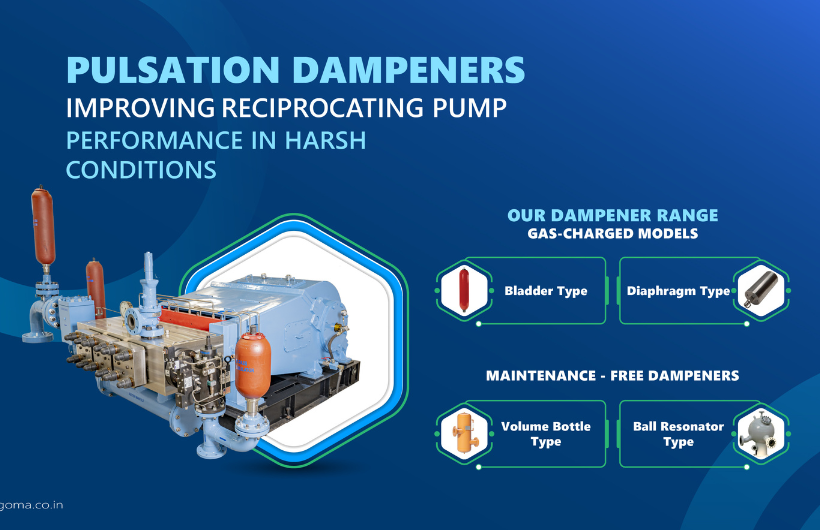
Gas-Charged Dampeners
• Bladder Type Uses a flexible bladder to separate the gas cushion from the process fluid. Ideal for high-pressure applications and offers rapid response to pressure fluctuations.
• Diaphragm Type Incorporates a diaphragm membrane to isolate gas and liquid. Suitable for chemical injection systems and moderate flow applications.
Maintenance-Free Dampeners
· Ball Resonator: A spherical chamber that uses a specific internal volume and neck geometry to create an acoustic interference pattern, cancelling out pressure pulses through resonance without the use of a flexible bladder.
· Volume Bottle: A simple, larger pressure vessel that acts as a storage reservoir to absorb flow fluctuations and smooth out pressure spikes through the sheer compressibility of the fluid
Correct type and size selection must always be based on engineering evaluation.
Pulsation Studies & Dampener Selection Methodology
At Goma Pumps & Systems, pulsation control starts with analysis.
We understand pulsation physics and how pressure waves behave in reciprocating pump systems. Our engineering team performs detailed pulsation studies and dampener selection studies to ensure proper integration.
Our scope includes:
- Evaluation of pump operating parameters
- Analysis of suction and discharge piping
- Dampener volume calculation
- Gas pre-charge pressure determination
- Verification of allowable residual pulsation
Selection is based on:
- Flow rate and discharge pressure
- Pump stroke frequency
- Fluid density and characteristics
- Piping length and configuration
- Operating temperature
Improper sizing can reduce effectiveness or create secondary vibration issues. Therefore, dampeners are engineered as part of the complete pumping system.
Material Selection, High Temperature & Compliance
In demanding industrial applications, material selection and design strength are critical.
Goma manufactures pulsation dampeners in:
• Carbon Steel
• Stainless Steel
• Duplex / Super Duplex
• Special metallurgy for corrosive service
For high-temperature applications, elastomer-free designs are recommended to ensure durability and long service life.
Where required, dampeners are designed and manufactured as per ASME Section VIII and can be supplied with U-Stamp certification.
This ensures structural integrity, code compliance, and suitability for critical high-pressure installations.
Integrated System Engineering Approach
At Goma Pumps & Systems, we do not treat pulsation dampeners as standalone accessories.
We Understand Pulsation Physics. We Perform Pulsation Studies. We Engineer Proper Selection. We Manufacture as per ASME Standards. We Design for High-Temperature and Harsh Operating Conditions.
Because in high-pressure applications, long-term reliability depends on stability.