11 February 2026
Hygienic Design Standards in Cup & Cone Filling Equipment
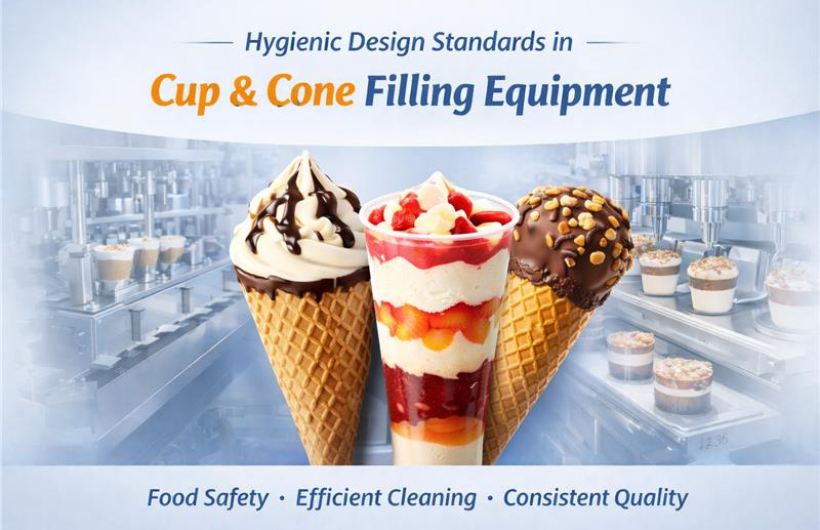
The frozen dessert market is evolving fast. From classic vanilla cups to layered chocolate cones loaded with nuts and sauces, today’s consumers expect indulgence, consistency, and above all, safety. Behind every perfectly filled cup or cone lies a critical factor that often goes unnoticed, Hygienic Design Standards in Cup & Cone Filling Equipment.
In modern ice cream manufacturing, the filling stage is one of the most sensitive phases of production. Unlike fully closed processing systems, the product is exposed during cup or cone filling before final sealing. This makes the design of the cup and cone filling machine extremely important. Any compromise in equipment hygiene can lead to contamination risks, product residue buildup, and increased cleaning downtime within an ice cream plant.
Why Hygienic Design Matters in Ice Cream Filling
A well-engineered hygienic cup & cone filling machine is designed to prevent bacterial growth, eliminate contamination traps, and ensure easy cleaning. Food-contact parts must be manufactured using corrosion-resistant stainless steel with smooth surface finishes to minimize microbial adhesion. Sharp corners, dead pockets, and inaccessible joints must be avoided to prevent product accumulation.
Equally important is CIP-enabled filling equipment. Clean-In-Place systems allow internal cleaning without dismantling key components, improving sanitation efficiency and reducing production interruptions. In high-volume operations within an ice cream process plant, this directly translates into faster turnaround times, reduced downtime, and improved production efficiency.
Automation also plays a vital role. A PLC-controlled automatic cup and cone filling machine reduces manual handling, ensuring consistent portion control while lowering contamination risk. Precision-driven filling systems maintain uniformity across batches, which is critical for brand consistency in commercial frozen dessert production.
It is important to note that hygienic filling performance also depends on upstream processing. Equipment such as a high-pressure homogenizer ensures a smooth, stable ice cream mix before it reaches the filling stage. When homogenization and filling systems are both designed with hygiene in mind, overall product quality and safety significantly improve.
GOMA’s Approach to Hygienic Cup & Cone Filling
Goma’s Cup & Cone Filling Machine for Ice Cream & Frozen Dessert Cups is engineered to combine hygiene, precision, and scalability. The system integrates multiple
functional stations that manage the complete filling process in a controlled and efficient manner.
The machine includes automated de-stacking of cups or cones, volumetric or servo-driven ice cream filling, chocolate spraying, fruit and nut dispensing, lid placement, cone pressing, and final discharge. Each station is designed to maintain smooth product flow and minimize contamination risk while ensuring accurate filling and topping application.
This integrated design allows manufacturers to produce:
· Ice cream cups and cones
· Multi-layered frozen desserts
· Topping-rich gourmet products
· High-volume commercial batches
By combining hygienic construction with intelligent automation, the system supports both product innovation and large-scale production inside a modern ice cream plant.
Hygiene as a Long-Term Investment
Implementing a properly designed ice cream cone filling machine is not just about meeting food safety regulations. It improves efficiency, reduces waste, and protects brand reputation. Faster cleaning cycles, minimal human intervention, and consistent product quality all contribute to better overall equipment effectiveness.
As demand for premium and specialty frozen desserts continues to grow, manufacturers must rely on equipment that meets strict hygienic design standards while delivering high performance. In today’s competitive market, hygiene is no longer optional, it is a benchmark for sustainable and scalable production.
With advanced engineering and hygienic filling technology, Goma supports modern ice cream process plant operations in producing safe, consistent, and high-quality frozen desserts with confidence.