06 November 2026
High-Pressure Reciprocating Pumps in Oil & Gas: Applications, Selection & Performance
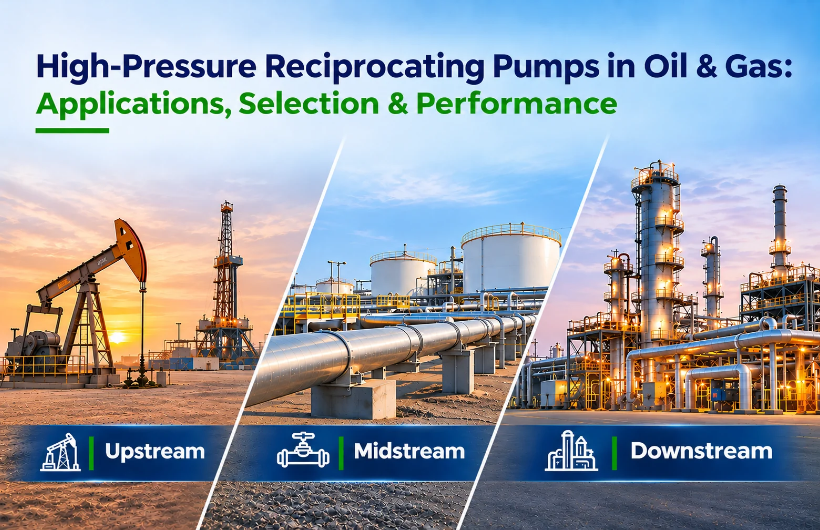
High-pressure reciprocating pumps are critical equipment in Oil & Gas operations where fluids must be delivered at high pressure with controlled flow and dependable performance. Unlike conventional centrifugal pumps, reciprocating pumps use positive displacement to move a defined volume of fluid during each operating cycle. This makes them well suited for applications where pressure, accuracy and consistent flow are essential.
Applications in Oil & Gas
High-Pressure Reciprocating Pumps in Oil & Gas: Applications, Selection & Performance
High-pressure reciprocating pumps play a critical role in Oil & Gas operations where fluids must be transferred, injected, circulated or tested under demanding pressure and temperature conditions. Their positive-displacement principle enables controlled flow delivery and high-pressure operation, making them suitable for applications across upstream, midstream and downstream facilities.
Upstream Applications
Upstream applications involve the exploration, drilling and production of oil and gas. High-pressure reciprocating pumps are used in these operations to inject fluids, transfer hydrocarbons and support well and reservoir management activities.
Produced Water & Polymer Injection
API 674 pumps are essential for reinjecting produced water and industrial effluents into reservoirs or disposal wells. They handle high pressures and are designed to manage corrosive fluids and suspended solids, supporting reservoir pressure maintenance, enhanced oil recovery (EOR), and environmental compliance.
Crude Oil Transfer
These pumps are used to transfer crude oil from storage tanks to transport vehicles or pipelines. They are built to handle the high viscosity and abrasiveness of crude oil, ensuring consistent flow rates and reliability in oil dispatch operations.
TEG/MEG Injection
API 674 pumps are used to inject methanol and glycol into pipelines to prevent hydrate formation and ensure flow assurance in oil and gas production. They deliver chemicals at high pressures to protect pipeline integrity and maintain safe operations.
HC Condensate Transfer
Used for transferring condensate, a byproduct of natural gas processing or steam turbines. These pumps maintain necessary pressure and flow rates for downstream processes or re-injection, handling light hydrocarbon liquids with reliability.
Hot Oil Circulation
Hot oil circulation is a process used in Enhanced Oil Recovery (EOR) to improve crude oil flow by reducing viscosity. It involves injecting heated oil or fluids into the well to dissolve blockages like wax or paraffin in the production tubing. By raising the temperature, viscosity decreases, facilitating oil flow to the surface.
Mobile Pumping Unit (MPU)
Pumps mounted on trucks for portable applications in emergencies, temporary operations, or remote locations. They are designed for flexibility and reliability in dynamic environments, supporting rapid deployment and effective fluid handling.
Midstream Applications
Midstream applications involve transporting, storing and processing oil and gas between production sites and refineries or end users. High-pressure reciprocating pumps support reliable fluid transfer, pipeline flushing, pressure testing and system restart operations.
Slop Transfer
They are designed to transfer collect and transfer slop, which includes oily residues and waste which spill over during pigging operations of pipelines. They handle abrasive and viscous fluids efficiently, ensuring effective treatment, disposal, or reprocessing while minimizing environmental impact.
Restart Rocking
During pipeline or process-system restart, static resistance, trapped fluids or elevated backpressure can make initial movement difficult. A reciprocating pump can provide controlled pressure and flow to assist the restart sequence, helping overcome initial resistance while maintaining system control.
Pipeline Flushing & Testing
High-pressure reciprocating pumps are used to introduce water or other approved test/flush fluids into pipelines. They can provide the controlled flow required for flushing and the pressure required during hydrostatic testing, helping verify pipeline integrity before commissioning or after maintenance.
Downstream Application
Downstream applications involve refining, processing and treating crude oil and petroleum products. High-pressure reciprocating pumps are used to deliver fluids such as wash water, chemicals and hydrocarbons at controlled flow rates and pressures, supporting reliable and efficient refinery operations.
Wash Water Injection
Wash water injection pumps in refineries remove salts and contaminants from process streams, protecting equipment and enhancing efficiency. Operating at high pressures, these pumps prevent corrosion and fouling in downstream units.
Selection & Performance
Selecting a high-pressure reciprocating pump requires evaluation of flow rate, discharge pressure, fluid properties, temperature, suction conditions, materials, duty cycle and required reliability. Wetted-part materials, sealing systems, valves, lubrication and pulsation control should be engineered around the specific service.
For Oil & Gas facilities, the objective is not simply to achieve high pressure, but to deliver stable, controlled and reliable performance under actual operating conditions. A correctly engineered reciprocating pump package can provide the durability and process control required for demanding hydrocarbon, injection, transfer and testing applications.
Engineering the Right Solution
High-pressure reciprocating pumps are not simply pressure-generating machines; they are engineered systems designed around specific process requirements. For Oil & Gas applications, selecting the correct pump configuration, materials and operating parameters is essential for achieving safe, reliable and efficient performance.
With the right engineering approach, high-pressure reciprocating pump systems can provide the pressure stability, durability and operational reliability required for demanding Oil & Gas applications.