09 October 2026
Water Jetting vs. Mechanical Cleaning: An Engineering Comparison
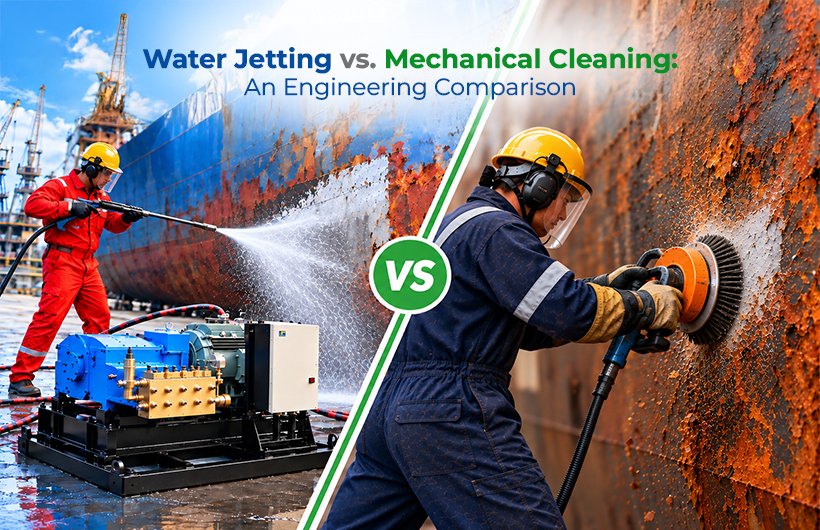
Cleaning industrial equipment has evolved significantly over the years. While mechanical cleaning methods have traditionally relied on manual tools, brushes, scrapers and abrasive techniques, water jetting introduced a more controlled approach by using high-pressure water to remove deposits, scale, coatings and contaminants. Today, water jetting has become an important cleaning technology across industries where conventional methods can be slow, labour-intensive or difficult to apply.
From Manual Cleaning to High-Pressure Water Jetting
Mechanical cleaning has been used for centuries because of its simplicity. Workers physically removed unwanted material using tools and equipment suited to the surface and application. However, as industrial systems became larger, more complex and harder to access, the limitations of purely mechanical methods became increasingly evident.
The development of high-pressure water jetting pumps provided an alternative based on hydraulic energy rather than direct mechanical contact. Instead of relying on a tool striking or scraping the surface, a focused water jet delivers energy directly onto the contaminant. This principle allows cleaning to be performed with greater reach and adaptability while reducing dependence on physical contact with the surface.
Water Jetting vs. Mechanical Cleaning
The fundamental engineering difference lies in how cleaning energy is transferred. Mechanical cleaning applies force through physical contact, whereas water jetting converts pump pressure into high-velocity water capable of breaking the bond between deposits and the surface.
Water jetting offers several advantages:
- Reduced physical contact: Cleaning can be performed without abrasive tools directly contacting the surface.
- Better access: High-pressure water can reach difficult areas, narrow passages and complex geometries.
- Versatile cleaning: The same basic principle can address scale, deposits, coatings and other unwanted material, depending on pressure and nozzle selection.
- Controlled cleaning: Pressure, flow and nozzle configuration can be selected according to the cleaning requirement.
- Improved productivity: High-pressure systems can reduce manual intervention and make repetitive cleaning operations more systematic.
Mechanical cleaning still has its place, particularly where deposits require direct physical removal or where water cannot be used. However, for demanding industrial cleaning applications, water jetting provides an engineering-driven alternative that combines pressure, flow and nozzle technology to deliver targeted cleaning performance.
The GOMA Engineering Perspective
Effective water jetting is not simply about generating high pressure. Pump selection, pressure stability, flow rate, nozzle design and system configuration all influence the final cleaning result. A properly engineered water jetting system therefore treats the pump and cleaning equipment as an integrated system rather than an isolated component.
The shift from mechanical force to hydraulic energy represents an important evolution in industrial cleaning—making water jetting a powerful solution where precision, accessibility and controlled cleaning performance matter.


