23 December 2025
The Role of Hygienic Homogenization in the Pharmaceutical Industry
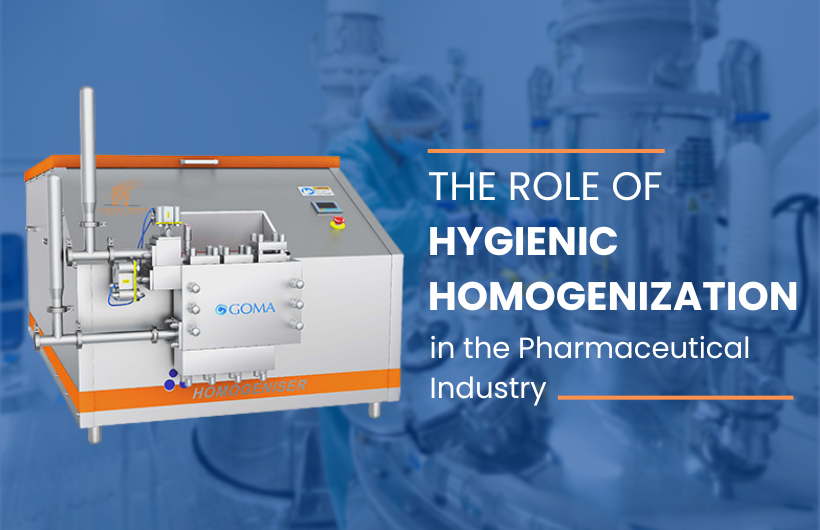
The pharmaceutical industry operates under some of the most stringent quality and regulatory standards in manufacturing. Every process step, from raw material handling to final formulation, must be tightly controlled to ensure product safety, consistency, and compliance. Within this environment, homogenization plays a critical role, particularly for liquid, semi-solid, and suspension-based pharmaceutical products.
Hygienic Homogenization is not simply a processing requirement; it is a quality-critical function that directly influences regulatory compliance, batch reproducibility, and patient safety. Process technology companies such as Goma focus on developing homogenization systems that align with the demanding expectations of the pharmaceutical industry.
Hygienic Equipment Design in Pharmaceutical Manufacturing
In pharmaceutical manufacturing, equipment design is closely scrutinized during audits and inspections. Homogenizers, being product-contact equipment, must be engineered to prevent contamination, product residue retention, and microbial growth.
Pharmaceutical homogenization systems are typically manufactured using SS 316L contact components, smooth internal surface finishes, and sanitary connections. These design elements allow effective cleaning and sterilization while minimizing the risk of cross-contamination between batches. Hygienic seals and FDA-compliant materials further support long-term reliability in regulated environments.
At Goma, hygienic design is embedded into homogenizer engineering to ensure compatibility with pharmaceutical production standards.
Meeting GMP Expectations Across the Pharmaceutical Industry
Good Manufacturing Practices (GMP) form the backbone of pharmaceutical production. Homogenizers used in the industry must support validated processes, controlled operating conditions, and documented cleaning procedures.
Modern pharmaceutical homogenizers are designed to operate with CIP (Clean-in-Place) and SIP (Steam-in-Place) systems, enabling repeatable and verifiable cleaning cycles. This capability is essential for manufacturers handling multiple formulations or operating continuous production schedules.
Goma supports pharmaceutical manufacturers by offering homogenization solutions that integrate with GMP-compliant process lines and provide documentation required for equipment qualification and validation.
Impact on Pharmaceutical Product Quality
Hygienic homogenization directly affects key quality attributes in pharmaceutical products. Uniform particle size distribution improves formulation stability, ensures accurate dosing, and enhances product performance. At the same time, hygienic processing minimizes the risk of contamination that could compromise product safety or regulatory approval.
Consistent homogenization performance also supports batch-to-batch repeatability, which is essential for maintaining quality across commercial production runs. Homogenizers designed for pharmaceutical applications must deliver precision without compromising cleanliness.
Supporting R&D and Commercial Scale Operations
Within the pharmaceutical industry, homogenization requirements extend from formulation development to full-scale manufacturing. Equipment used during R&D and pilot trials must replicate production conditions closely to avoid scale-up challenges.
Process technology providers like Goma design homogenization systems that maintain consistent performance across different production scales. This approach enables pharmaceutical manufacturers to transition smoothly from development to commercialization while maintaining hygienic and regulatory standards.
Custom Homogenization Solutions for Pharmaceutical Applications
Pharmaceutical formulations often present complex processing challenges, including high viscosity, shear sensitivity, or sterile processing requirements. In such cases, standard homogenizer configurations may not be sufficient.
Custom-engineered homogenization systems allow pharmaceutical manufacturers to address these challenges while maintaining GMP compliance. Goma offers tailored homogenization solutions designed around specific pharmaceutical applications, ensuring optimal performance without compromising hygienic integrity.
In the pharmaceutical industry, hygienic homogenization is a critical contributor to product quality, regulatory compliance, and manufacturing reliability. Equipment designed with hygienic principles, validated cleaning capabilities, and process consistency supports the high standards expected in regulated pharmaceutical environments.
Through hygienic engineering and pharmaceutical process expertise, Goma supports the pharmaceutical industry with homogenization solutions designed for clean, compliant, and consistent manufacturing operations.