20 November 2026
Sweetened Condensed Milk Processing: Process Engineering, Equipment Selection and Critical Parameters
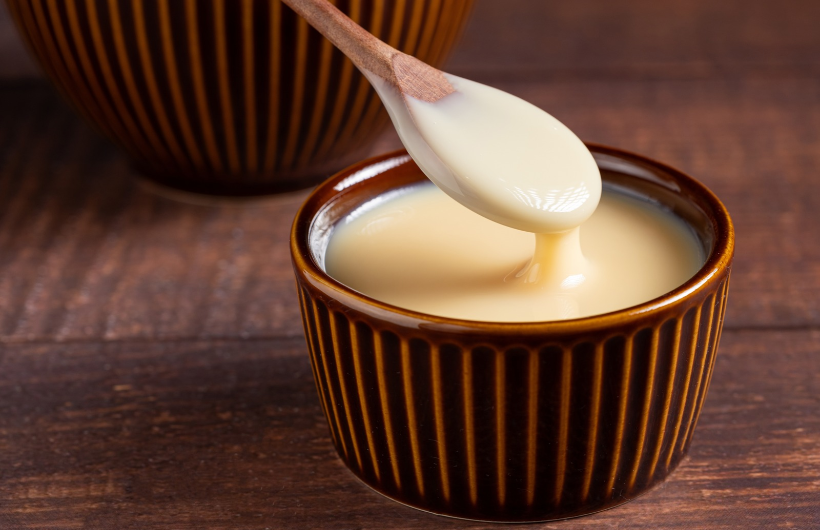
Sweetened Condensed Milk (SCM) is a concentrated dairy product widely used in confectionery, bakery, chocolate, ice cream and dessert applications. Its production requires precise control over milk composition, evaporation, sugar addition, viscosity and lactose crystallisation.
At an industrial scale, achieving consistent product quality depends on more than simply concentrating milk. It requires an integrated processing line with properly selected equipment, efficient heat transfer, controlled product handling and reliable automation.
At GOMA Process Technologies, the focus is on designing integrated dairy processing solutions that ensure efficient operations, hygienic processing and consistent finished product quality.
Process Flow and Plant Configuration
A typical industrial sweetened condensed milk processing line consists of the following stages:
Raw Milk Reception → Filtration → Chilling → Storage → Clarification → Cream Separation & Standardisation → Preheating → Vacuum Evaporation → Sugar Addition / Syrup Blending → Final Concentration → Cooling → Lactose Seeding → Controlled Crystallisation → Storage → Filling & Packaging
The actual process configuration depends on the selected manufacturing method, product formulation, plant capacity and customer requirements.
1. Milk Reception, Separation and Standardisation
The process begins with raw milk reception, filtration and quality inspection.
Standardisation is carried out to achieve the required fat and solids-not-fat (SNF) composition as per the product formulation.
GOMA Engineering Focus:
- Hygienic milk reception and storage tanks.
- Milk clarification and cream separation systems.
- Standardisation arrangements for consistent product composition.
- Hygienic product transfer pipelines and valves.
2. Vacuum Evaporation
Vacuum evaporation is the core concentration operation. Industrial vacuum evaporators remove water under reduced pressure, allowing evaporation at lower temperatures and reducing excessive thermal exposure.
The evaporator is selected based on plant capacity, required concentration, product characteristics and energy efficiency.
Critical Process Parameters:
- Milk inlet temperature and preheating conditions.
- Evaporator operating vacuum and product temperature.
- Water evaporation capacity.
- Product residence time.
- Final total solids concentration.
3. Sugar Syrup Preparation and Blending
Sugar is a major ingredient in sweetened condensed milk and contributes to sweetness, viscosity and microbiological stability through increased osmotic pressure.
Where separate syrup preparation is adopted, a dedicated stainless steel tank with heating and agitation ensures uniform sugar dissolution. Controlled dosing and blending arrangements help maintain consistent product composition.
GOMA Engineering Focus:
- Sugar syrup preparation tanks with heating and agitation.
- Controlled sugar syrup dosing and transfer.
- Hygienic blending arrangements.
- Temperature and process monitoring.
4. Cooling and Controlled Lactose Crystallisation
Lactose crystallisation is one of the most critical stages in sweetened condensed milk production. Uncontrolled crystal growth can result in a grainy or sandy mouthfeel.
A dedicated cooling and crystallisation tank with an appropriately designed agitator and heat transfer arrangement helps maintain uniform product conditions.
Critical Parameters:
- Cooling rate and temperature profile.
- Lactose seed crystal quantity and dispersion.
- Agitation intensity.
- Crystallisation time.
- Final lactose crystal size.
5. Product Storage, Transfer and Packaging
Due to its high viscosity, sweetened condensed milk requires careful selection of product transfer pumps. Suitable positive displacement pumps, such as lobe or progressive cavity pumps, can be considered depending on product viscosity and required flow rate.
The filling system can be configured for cans, jars, pouches or other packaging formats based on production capacity and customer requirements.
6. Automation and Process Integration
An integrated PLC-based automation system can coordinate different processing stages and monitor critical operating parameters.
Engineering a Complete SCM Processing Line with GOMA
Designing a sweetened condensed milk plant requires a coordinated approach to process engineering, equipment selection and system integration.
GOMA Process Technologies focuses on developing processing solutions based on customer capacity, product formulation, operational requirements and future expansion plans.
Our engineering approach emphasises:
- Process Integration: Coordinating milk preparation, evaporation, sugar blending, cooling and crystallisation.
- Equipment Selection: Matching equipment to product characteristics and production requirements.
- Hygienic Design: Ensuring suitable product contact materials, piping arrangements and cleanability.
- Automation: Integrating process instrumentation and controls for consistent operation.
- Capacity Planning: Designing processing systems around production targets and packaging requirements.
Conclusion
Consistent sweetened condensed milk production depends on the right combination of process design, evaporation efficiency, formulation control and lactose crystallisation management.
A properly engineered processing line ensures that every operation, from raw milk handling to final packaging, works together efficiently.
GOMA Process Technologies brings together process engineering, equipment design and automation to develop integrated dairy processing solutions that support reliable, hygienic and consistent sweetened condensed milk production.