30 October 2026
API 674 Pumps for Oil & Gas Water Injection: Engineering Considerations for Reliable Injection Systems
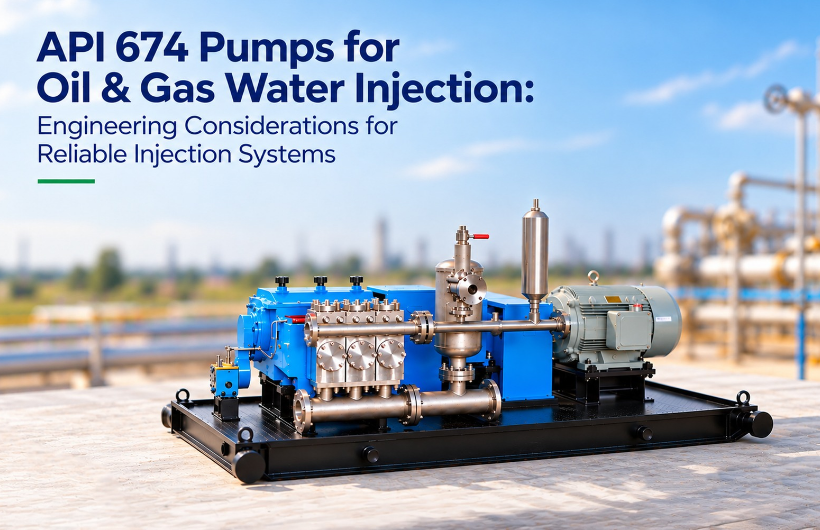
Water injection is an important part of oil and gas field operations, supporting reservoir pressure management and, in suitable applications, helping maintain hydrocarbon production. As injection systems operate under demanding pressure and flow conditions, the pumping system must provide consistent performance, reliability and controlled delivery. This makes the selection of a suitable high-pressure reciprocating pump a critical engineering decision.
Why API 674 Pumps Matter in Water Injection
Produced water or other treated water used for injection may require treatment and conditioning before it enters the injection system. The water quality, compatibility with formation water and operating conditions can influence scaling, corrosion, plugging and injectivity. IOGP guidance on produced-water injection highlights the importance of water properties, treatment, process monitoring and injection-well considerations.
API 674 provides a framework for reciprocating positive-displacement pumps used in demanding industrial services. For oil and gas water injection applications, an appropriately engineered API 674 pump can provide the controlled flow and high-pressure capability required by the process.
Key Engineering Considerations
1. Pressure and Flow Requirements
Pump selection begins with defining the required injection flow and discharge pressure. The pump must be capable of meeting the operating duty while accounting for system pressure losses, changes in operating conditions and the required injection pressure.
2. Water Quality
Injection water can contain suspended solids, dissolved minerals, hydrocarbons or other contaminants. Proper pretreatment and filtration are therefore important for protecting the pump and downstream injection system. Inadequate water conditioning can contribute to wear, scaling and reduced injectivity. Wetted parts, including the pump head, plungers, valves and fluid-end components, should be selected based on water chemistry, chloride levels, temperature and pressure.
The amount of water required for injection depends on the well’s injectivity, reservoir pressure, formation permeability and the required production objective. For proper pump suction, the pump must receive a continuous, adequate water supply at the specified suction pressure and flow rate; the injection volume itself does not determine suction. The required injection rate should therefore be established from well testing and reservoir calculations, then used to size the pump, suction line, storage tank and associated equipment.
3. Pulsation and Flow Stability
Reciprocating pumps generate pulsating flow. Proper hydraulic design, pulsation control and system integration are essential to maintain stable operation and protect connected piping and equipment. Less Bends, Proper Suction Conditions, and
4. Reliability and Continuous Operation
Water injection systems can be critical to field operations. Pump construction, materials, sealing arrangements, lubrication, monitoring and maintenance accessibility should therefore be considered during equipment selection rather than focusing only on rated pressure and flow.
Designing the Complete Injection System
An API 674 pump should not be considered as an isolated component. Filters, treatment systems, valves, manifolds, instrumentation, pulsation control and injection wells must work together as an integrated system. Monitoring pressure, flow and water quality can help operators identify developing issues before they affect injection performance.
Conclusion
Reliable water injection depends on more than achieving the required discharge pressure. It requires the right combination of water treatment, hydraulic design, pump engineering, monitoring and operational control. API 674 reciprocating pumps can form a critical part of this high-pressure infrastructure when selected and engineered around the actual application requirements.
For oil and gas operators, the objective should be a water injection system designed for reliable pressure delivery, controlled flow and long-term operational performance.